Trust as Infrastructure: Why Critical Minerals Projects Keep Getting Stuck
Category
Topics
By Yiannis Chrysostomidis, Tim Vickery, and Jeremy Weate
This blog is a brief summary of “Trust As Infrastructure: Five Patterns From the Mining Sector About Why Critical Minerals Projects Get Stuck”. The full synthesis will be published in October 2026.
Consider a copper mining project; we will call it Site X.
An exploration company holds the licence in the early 2010s, drills the deposit, proves its grade, and makes a series of local commitments along the way, including a contribution to a school and a road improvement (some but not all of these commitments are kept). The exploration team rotates through, and in 2018, the asset is sold to a mid-tier operator. Of course, the geological data transfers in full, but the relational data does not transfer beyond what a few retained people remember, and most of those people have left by the time the asset changes hands.
The new operator commissions a comprehensive Environmental and Social Impact Assessment (ESIA) in 2019, and the process is rigorous and well-documented, but it works from a relational baseline that is not well-grounded. In 2021, the social performance team raises concerns about a deterioration in community relations. They do not have authority over project scheduling, and the commercial timelines do not change in response. In 2023, a serious dispute arises. The budget for response is significant. The budget for prevention had been cut two years earlier. In 2025, the project is suspended due to community opposition, and in 2026, a different operator begins discussions about acquiring it.
Site X is a composite drawn from six months of confidential conversations we held with senior practitioners and advisors across the mining sector in responsible sourcing, social performance, strategy, and finance. No single project they described produced all of these dynamics in exactly this combination, yet most produced several. Nothing in this story is unusual, which is what makes it worth examining.
When an early-stage project like Site X fails to move to production, the losses are distributed across the system.
The communities around it are left with the disruption of exploration and early works, but few of the promised benefits, often with damaged relationships, and perhaps even feelings of betrayal that result in anger and loss of trust in industry as a whole and the local and national government. The government loses potential revenue and credibility, and politicians probably lose votes. The company and its financiers write down the investment, and the minerals stay in the ground while demand for them grows. Nobody designed this outcome, and probably almost nobody wanted it.
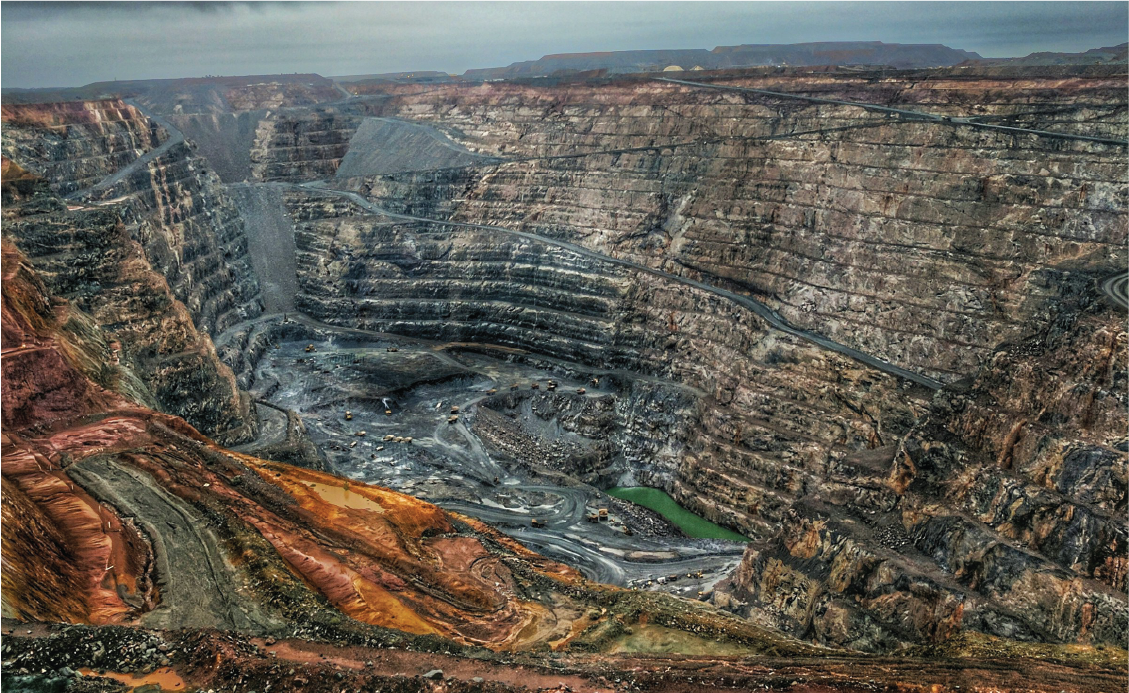
Photo credit: Matthew de Livera / Unsplash
The scale of this example playing out in reality across the world is significant. Peru has seen over $53 billion in stalled mining projects, according to industry estimates reported in 2022. First Quantum Minerals' Cobre Panamá, a $10 billion investment, and one of the world's largest copper mines, has been suspended since late 2023 due to the perception of environmental risks and an unfair deal.
The demand context makes the pattern harder to live with, since the International Energy Agency (IEA) projects a two- to four-fold increase in demand for critical minerals by 2040, with copper alone facing a 30% supply shortfall by 2035. More mining will need to happen, often in more contested places and under more scrutiny than the sector has previously experienced, but if projects continue to stall at the current rate, the pattern of distributed losses will keep repeating and vital supplies of minerals for the energy transition, AI-driven demand, defence and the overall economy will never make it into supply chains.
The sector has invested significantly in responsible mining frameworks and standards over two decades to avoid situations like this. From the development of the Consolidated Mining Standard Initiative, convened by the International Council on Mining and Metals (ICMM) with others, and the industry norm of the International Finance Corporation (IFC) Performance Standards to the protocols around free, prior, and informed consent (FPIC), work in the sector has meaningfully raised the floor of good practice.
The causes of stalled projects are well known, but less clear is why so much of what the sector knows does not translate into practice.
Let’s look at our fictional story to explore some answers.
Start with the handover of Site X in 2018. Explorers and mining companies maintain detailed, transferable records of geology, and the technical history of a deposit moves comprehensively from one operator to the next, regardless of how many times the concession changes hands. The relational history of the same site is treated very differently. As noted, what was promised during exploration, what was agreed and what was forgotten, which families gave consent and which did not, all of this tends to live in informal channels, and almost none of it is systematically captured. What little may be saved, rarely transfers when the asset changes hands. One practitioner told us that by the time a mine starts operating, 15 different companies may have come and gone, and each one acts as if they are the first, but communities keep track. A key structural reason that relational information is not prioritised is the business model for early stage work and the associated incentives. With no revenue coming in until they sell to an operator, many exploration companies ‘find, prove, and flip.’ They have limited commercial incentive to invest in relationships they will not be present to see mature. The operator who bought Site X inherited the geology in full and the relational damage, with no record of it.
Then there is the budget decision in 2021. Many people we spoke with said that preventive investment in relationships and trust-building matters, and that leadership teams approve of the principle, but lack the incentive or often the skill set to do it adequately. The dispute, when it happens, is about the budget, and preventive investment tends to lose to immediate operational priorities consistently, across most of the companies our interviewees described. A key structural reason here is visibility. In other words, the crisis that is prevented is unknown, it leaves no trace, generates no urgent budget conversation, and champions no careers. There is no glory in prevention. Whereas, a crisis response is dramatic, urgent, attributable, and often career-defining. The people charged with preventing the crisis may even be blamed. Site X cut its prevention budget two years before the dispute that prevention would have helped avoid.
Then there is the question of authority. The social performance team at Site X observed deteriorating trust among community members over two years and could not modify the project schedule in response. We heard versions of this across the conversations where the people best placed to identify emerging challenges or discontent can usually see them before they become crises, but often they do not have the authority to intervene, to act on what they see. Partly, this is because the social performance function is valued very differently across different parts of the same company. It is a market enabler and ‘operational insurance’ in one place and a cost centre or a schedule delay in another.
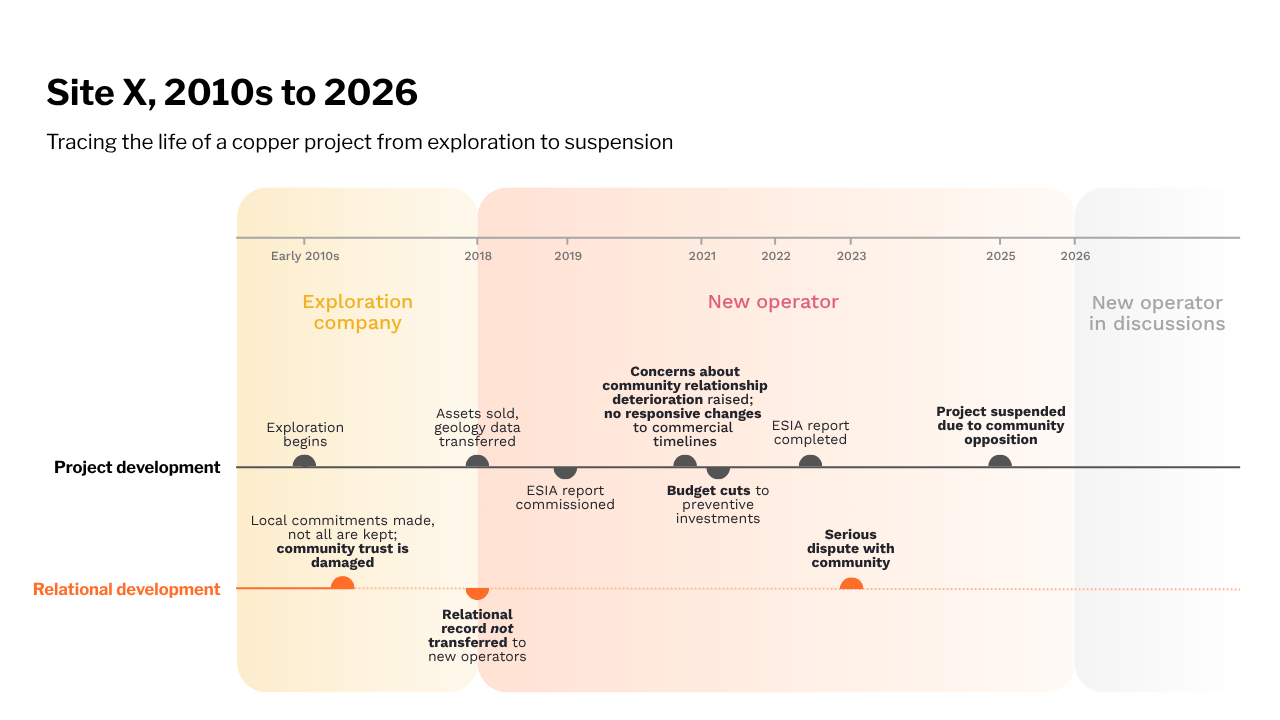
Visual timeline of the Site X project from exploration to suspension
Placing value on relationships & the cost of treating trust as soft
The thread running through these failures is how the sector values relationships and the trust that underpins them. Site X lost, or failed to earn, the enduring trust that would have allowed it to operate. The relationships that determine whether a project proceeds, fails, or eventually produces minerals are largely treated as 'soft'. They are not seen as part of the foundational value of the asset. No KPIs are attached to them.
Trust as infrastructure
The story of Site X suggests this framing is a mistake, because in practice, relationships and the trust that underpins them function like grid infrastructure. Like a water, energy, or transport grid, the quality of relationships around a project determines whether everything else can run. When trust holds, projects have a stronger foundation. When it breaks down, even technically sound projects can stall. Unlike power lines, irrigation and sewage systems or bridges that can be repaired relatively quickly with adequate funding, trust is not material. It is hard to build back better after a crisis. As Warren Buffett famously said, "It takes 20 years to build a reputation and five minutes to ruin it. If you think about that, you'll do things differently." Crucially though, like other infrastructure, trust can be designed for, invested in, maintained, and potentially rebuilt over time. But its absence carries costs that tend to exceed, by a significant margin, the cost of earning and keeping it.
Taking the framing seriously would change industry practice in concrete ways. It would mean a relational record sits alongside the geological record, structured and tied to the site rather than to whichever company holds the concession. It would mean engaging, listening and partnering with communities when exploration starts, rather than when the formal impact assessment begins. It would mean measuring whether trust grew or eroded, understanding why and taking remedial action, rather than focusing only on whether the relevant procedures were followed. And it would mean giving social insight holders on the team the authority to slow a project down, which is where most organisations currently stop short.
This is not a rejection of existing industry frameworks, which are necessary but not sufficient on their own. The issue is about complementarity. It involves building the capabilities to invest in, earn and hold relationships over time, to navigate complexity, and to lead through uncertainty, changing the structures that currently value this work at close to zero until the moment it fails and becomes a cost.
One important thing to note
What is most important to us as practitioners in the field of systemic collaboration is the integrity of the process by which a decision is reached, not whether a project ends up proceeding. When a project does not go ahead, that can also be a legitimate outcome rather than a failure, and we are not arguing that every project in this position should have proceeded. Some are declined by the communities affected through a sound process, which is at times the right result. The losses described earlier come from a different situation, where a project stalls after trust has broken down, commitments have gone unmet, and decisions have been made badly. So to reiterate, for us in Reos Partners, our concern is the quality of the process behind a decision, whether that decision is to proceed, to pause, or not to proceed at all.
The good news
These dynamics are produced by structures, and the good news is that structures can be changed. The change will need to be systemic and collaborative because no single actor can resolve the dynamics of which all of them are part. We are drawing what we heard into a fuller synthesis, which names five recurring patterns and maps how they reinforce one another, and a next phase of this work will centre the perspectives of the communities these projects most affect.
If you work in mining, finance, or policy, and Site X is familiar to you, we would value a conversation.
Yiannis Chrysostomidis, Jeremy Weate and Tim Vickery work on contested transitions at Reos Partners
Yiannis Chrysostomidis,
Associate Partner at Reos Partners
Jeremy Weate
Senior Advisor on Transition Minerals Value Chains at Reos Partners
Tim Vickery
Senior Advisor on Transition Minerals, Governance and Communication at Reos Partners